Category Archives: Catharine Ward Thompson

Shifting the ground of environmental design evidence

This week, we’re at one of the most important conferences of the year for us, the 47th conference of the Environmental Design Research Association (EDRA).

Logo for E D R A conference

Since its formation in the late 1960s, EDRA has used its annual congress to bring together design professionals, social scientists, students, educators, and facility managers.

For EDRA47, the Association has ‘come home’ to its birthplace of North Carolina, where its very first conference was convened by Henry Sanoff in June 1969, sponsored by NC State’s School of Design and UNC’s Department of City and Regional Planning.

Under the theme of Innovation : Shifting Ground, the aim of EDRA47 is to take a global look at the driving force of innovation in environmental design.

Catharine Ward Thompson’s plenary on environmental design evidence

Catharine (Director of OPENspace) is one of EDRA47’s six keynote and plenary speakers.

In her plenary, she is focusing on environmental design’s potential to help address current global health crises (such as cardio-vascular disease, rising levels of obesity, Type 2 diabetes, and mental illness) and growing inequalities in health and wellbeing.

Catharine’s presentation explores what kinds of approaches are needed if environmental design, and landscape design in particular, is to be taken seriously by public health policy makers and planners as both health-enhancing (salutogenic) and reducing of health inequalities (equigenic).

It therefore considers the importance of working across and between disciplines, the use of innovative of methods (such as biomarkers and mobile neural imaging), the particular challenges involved in longitudinal studies to research design interventions, and the opportunities offered by natural experiments.

Insights from current and recent OPENspace research

In Catharine’s plenary presentation, she will draw on research from large-scale, collaborative projects such as Mobility, Mood and Place (MMP), GreenHealth, and Woods In and Around Towns (WIAT).

Over the course of the four-day conference, which runs from Wednesday 18th to Saturday 21st May 2016, these projects will also be presented in a series of papers by OPENspace researchers including Dr Sara Tilley, Dr Eva Silveirinha de Oliveira and Professor Jenny Roe.

The themes covered by the papers include Longitudinal Studies and Natural Experiments; Childhood Experience, Adult Perceptions and Visits to Woodlands; Timescales in Environmental Influences on Mobility in Older Age; Older People’s Brain Activities and Self-Reported Experiences of Short Urban Walks; and Experiences of Outdoor Environments by Women with Postnatal Depression.

Colleagues from collaborating research centres, such as the Stockholm Environment Institute at the University of York, will also be presenting.

PhD candidate scoops EDRA Great Places Award

We’re delighted to end this post by announcing that PhD researcher, Matluba Khan, has won the EDRA Great Places Award in the Place Design category for her project, An Outdoor Learning Environment for Children.

Announced on the first day of the EDRA conference, the Award was given to Matluba for a “submission [which] truly exemplifies the concern for human factors in the design of the built environment, and a commitment to promoting the links between design research and practice”.

Matluba’s project is the co-design and build of outdoor learning and play space at a rural primary school in Bangladesh. Her PhD is co-supervised by Dr Simon Bell and Dr Eva Silveirinha De Oliveira at OPENspace, and Dr Sarah McGeown of Moray House School of Education.

In 2014, Matluba won Overall Best Paper Award at the 45th EDRA conference in New Orleans.

The annual Great Places Awards are a collaboration with the global organisation, Project for Public Spaces. Chaired by  John Shapiro of the Pratt Institute, this year’s jury included Kofi Boone (North Carolina State University), Jill Pable (Florida State University), Michael Mehaffy (Sustasis Foundation) and Katie Roden (Centerbrook Architects and Planners).

Two researchers with an award

Find out more about EDRA47 on the Environmental Design Research Association website

Thoughts on place on World Physical Activity Day

It’s World Physical Activity Day, and the theme this year is
“Active Child, Healthy Adult!”.

At OPENspace, we are particularly interested in the role that quality green space and natural environments have to play in enabling and encouraging people to be active, from childhood into oldest age.

Photo of a child cycling in a park

In the last week alone, Catharine Ward Thompson has touched on this theme at three events across Europe:

  • the International Green Care Forum on the Health Promoting Effect of Landscapes and Gardens (in Vienna);
  • a promotional lecture for the International Green Infrastructure Conference (in Ljubljana);
  • the Government Office for Science Foresight Future of Ageing event (in London).

We welcome the opportunity that World Physical Activity Day brings to shed further light on the associations between access outdoors and patterns of physical activity, and of the importance of these associations throughout the life course.

In 2008, we published a paper called ‘The childhood factor: Adult visits to green places and the significance of childhood experience’ in Environment and Behavior.*

Drawing on data collected in different parts of Britain, we reported a strong relationship between frequent childhood visits to woodlands or green spaces and the likelihood of visiting such places, alone, in adult life.

The data also suggested that the physical and the emotional benefits of access to green space are strongly reflected in childhood experience.

Eight years on, with stories of diminishing childhood time spent outdoors still in the news (see yesterday’s Irish Times, for example), we’d like to finish with some conclusions from our paper…

“People who often visited green places as children are more likely to associate natural areas with feeling energetic and more likely to visit green or wooded areas within walking distance of home, both of which suggest that habits of healthy outdoor exercise as adults are linked to patterns of use established in childhood.

People who were frequent visitors as children are also more comfortable visiting woodlands and green places alone as adults and more likely to think green spaces can be magical places.

It appears that such people have not just a physical relationship with green outdoor places but also an emotional one that influences how people feel about themselves and makes them more open to positive and elemental experiences in these places. Because lack of confidence in going to parks or natural areas on one’s own may be a serious deterrent to people enjoying the physical, social, and psychological benefits of outdoor activities (Burgess, 1998), it is important to establish whether childhood experience can be a factor in increasing confidence levels for adult visits to such places.

Concerns about increased restrictions on today’s children and their freedom to roam outdoors, as expressed in the focus groups in our projects and described in the literature, must be reinforced by the possibility that this will be a factor in limiting healthy outdoor exercise and positive relationships with the environment when today’s children are adults”.

* Ward Thompson, C., Aspinall, P. and Montarzino, A. 2008. ‘The childhood factor: Adult visits to green places and the significance of childhood experience’ Environment and Behavior 40 (1) pp. 111-143. doi:10.1177/0013916507300119

We’re launching a new MSc in Landscape and Wellbeing!

OPENspace is delighted to announce a new MSc in Landscape and Wellbeing at Edinburgh College of Art (ECA) at the University of Edinburgh.

The one-year programme will take an innovative and interdisciplinary approach to understanding the importance of the environment for human health and wellbeing.

Delivered by an expert academic team led by Professor Catharine Ward Thompson, it will draw on the most advanced theoretical and methodological research in the field and is aimed at academics and practitioners working in landscape architecture, planning, design, geography, public health, psychology, epidemiology, horticulture and ecology.

It is designed to help you understand the evidence base on salutogenic landscapes (those that support and enhance human health and wellbeing), translate research into practice, and guide more effective environmental interventions.

Find out more about the programme on the ECA website

> Watch a recording of an online Q&A about the programme
(Please note that this requires you to install and run Blackboard Collaborate)

Another step forward for the National Walking Strategy

The National Walking Strategy Action Plan for the next ten years has been released, along with a new website and an infographic on how we can all contribute to ‘getting Scotland walking’.

OPENspace team members have played an active role in both the development of the Strategy (which was launched in 2014) and the new Action Plan, with Catharine Ward Thompson being a member of its Working Group and Delivery Forum, and Sara Tilley contributing to a workshop on its implementation.

The vision for the National Walking Strategy is “a Scotland where everyone walks as part of their everyday journeys, places are well designed for walking and everyone enjoys walking in the outdoors”.

The Action Plan was announced by Jamie Hepburn, the Scottish Government Minister for Sport, Health Improvement and Mental Health, at a ScotLINK Active Health seminar on Thursday 3rd March.

Read the Action Plan on the Step Change Scotland website

Infographic on walking

Let’s Get Scotland Walking – the new National Walking Strategy infographic

Catharine Ward Thompson appointed Honorary Professor at the University of Exeter Medical School

Our Director, Catharine Ward Thompson, has been appointed an Honorary Professor at the European Centre for Environment and Human Health (ECEHH).

Launched in May 2011, and led by Professor Lora Fleming, the Centre is part of the University of Exeter Medical School.

ECEHH research falls into two major areas: emerging threats to health and wellbeing posed by the environment; and the health and wellbeing benefits the natural environment can provide.

Catharine’s three-year appointment marks a strengthening of links between OPENspace and ECEHH which builds on previous knowledge exchange activities, such as the Blue Mind Summit, Sara Warber’s study visit to Edinburgh, and the two-day meeting Fostering Sustainable Environments for Improving Future Health and Wellbeing.

Visit the European Centre for Environment and Human Health website

Catharine at a conference dinner

Catharine in Macedonia for WHO Task Force meeting

Greetings from Skopje in Macedonia where Catharine is presenting evidence on urban green spaces and health to the World Health Organization European Environment and Health Task Force (EHTF).

The Task Force is the leading international body for implementation and monitoring of the European Environment and Health Process, and we welcome the emphasis it is placing on the relationship between the quality of our urban outdoor spaces and people’s health and wellbeing.

We are delighted to have been invited to talk about our research to the group, framing the issue in the wider context of topics such as land use, urban planning, urban adaptation to climate change and demographic changes.

We are also pleased that the presentation is being followed by a discussion on the formulation of policy goals and political commitments in this area.

Keep an eye oLogo of the World Health Organization European Environment and Health Processn the EHTF website for outcomes from the meeting and details of the Sixth Ministerial Conference on Environment and Health in 2017.


OPENspace at EUROCITIES 2015

We’re at the EUROCITIES 2015 conference in Copenhagen / Malmo, where Catharine Ward Thompson is bringing a focus on the pedestrian environment to a roundtable on urban mobility.

It’s a pleasure to be in such esteemed company. Sitting to Catharine’s right (in the blue scarf) is Hella Dunger-Loeper, Permanent secretary and State of Berlin Delegate to the Federation and former Permanent Secretary for Building and Housing at Berlin’s Senate Department for Urban Development…Catharine Ward Thompson speaking at the Eurocities conference

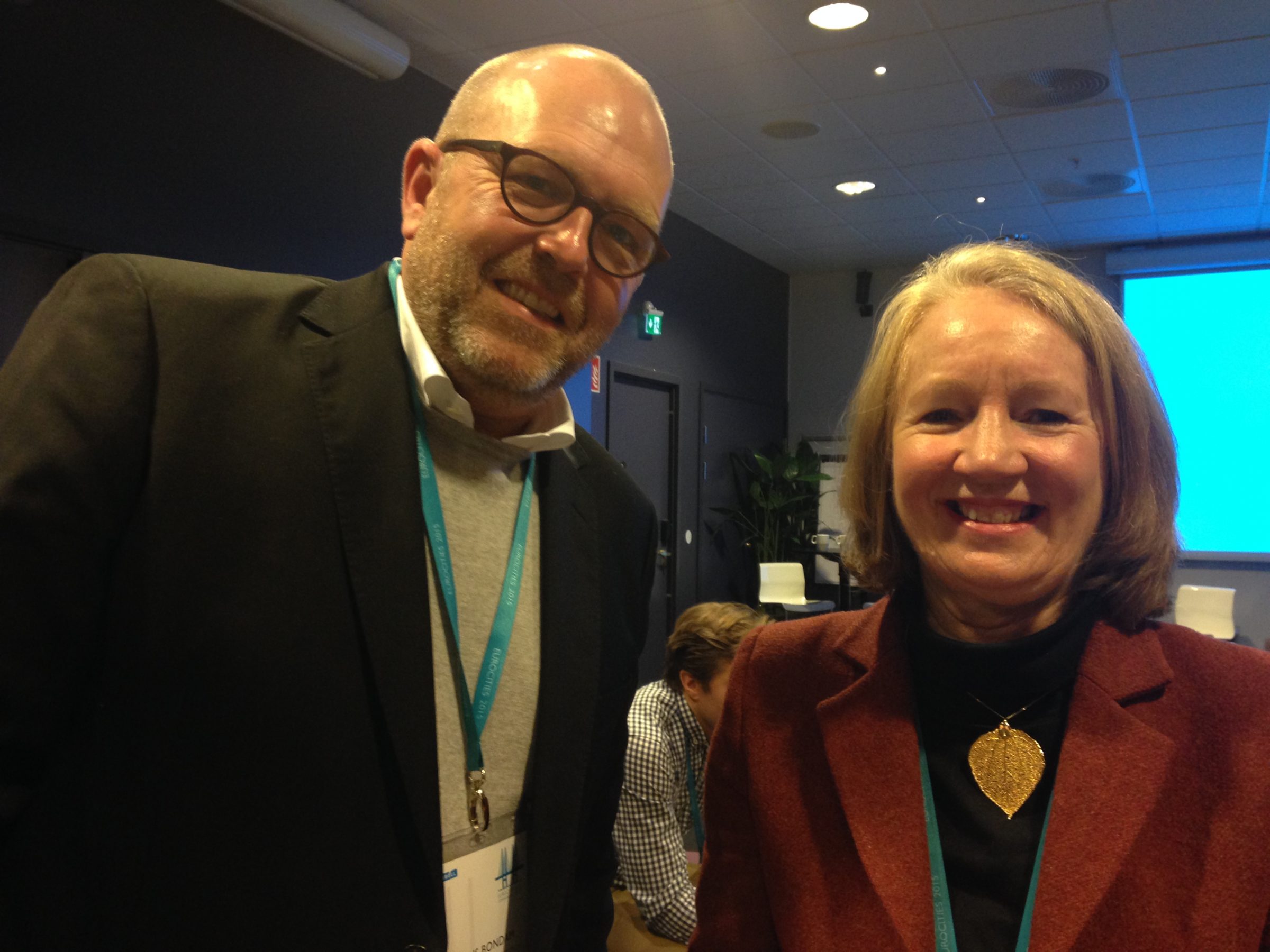
… and in this photograph, taken after the roundtable, she is pictured with panellist Klaus Bondam, Director of the Danish Cyclists’ Federation and former Chair of the EUROCITIES Mobility Forum…

Photo of Catharine Ward Thompson at Eurocities

Máire Cox also attends the conference to promote OPENspace research to policymakers within 130 of Europe’s largest cities.

And finally… we’re delighted to share the news that the City of Edinburgh won a EUROCITIES award at the conference for community participation in making the city more attractive and sustainable.

Logo for EUROCITIES 2015

More about EUROCITIES 2015, the focus of which was ‘sustainable growth and quality of life’

Can landscape design actually improve health?

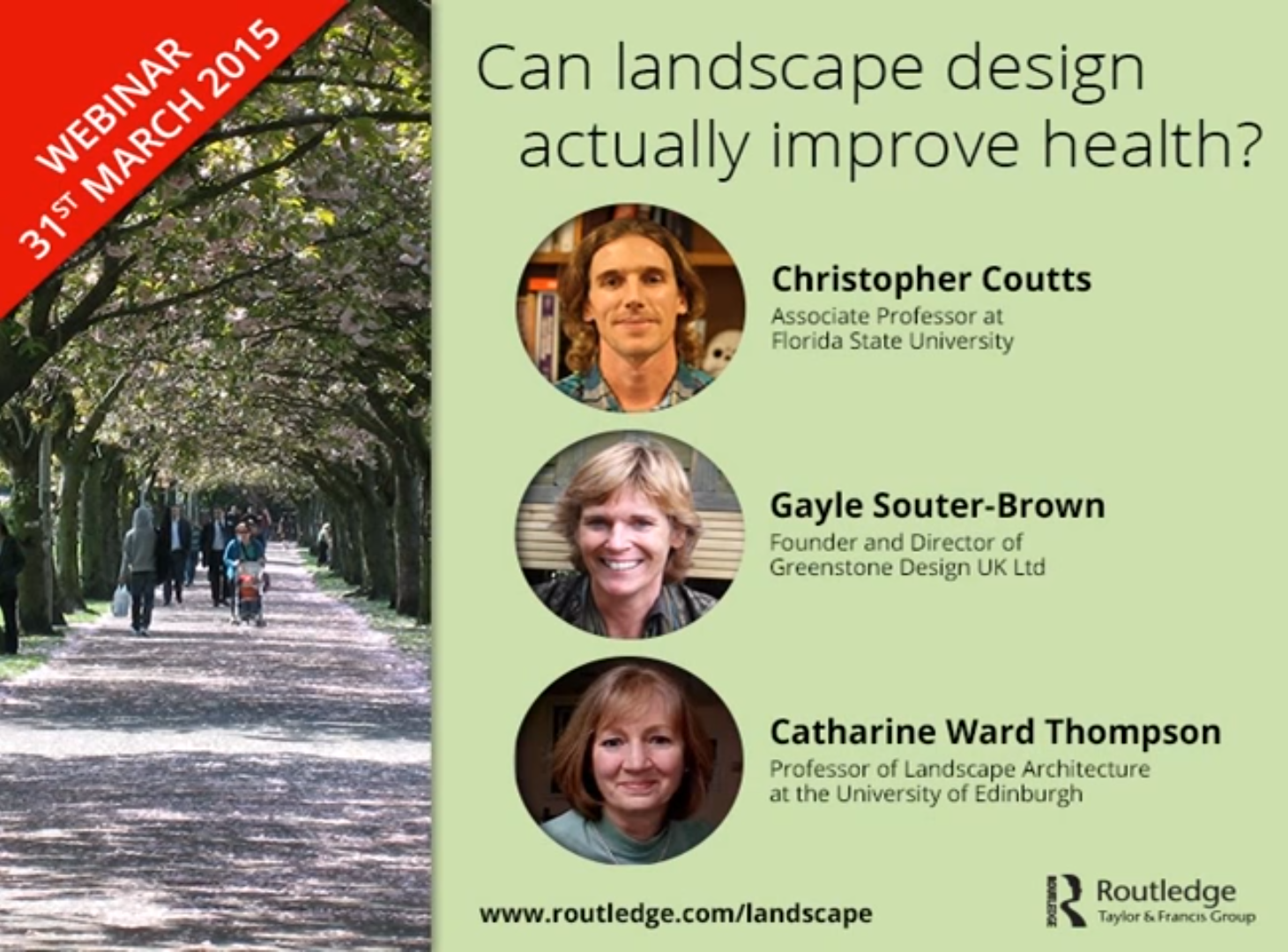
Catharine Ward Thompson, Director of the OPENspace research centre, has taken part in a free webinar on the potential of landscape design to improve health.

The event was hosted by Routledge, publishers of the Open Space : People Space books.

Screengrab from a landscape and health webinar

Selecting this image will take you to a recording of the webinar on YouTube

Joining Catharine online were Christopher Coutts (Florida State University) and Gayle Souter-Brown (Greenstone Design UK Ltd).

Together, they discussed the prime importance of landscape design on health and the ways that you can change this dynamic through effective design and specific interventions.

> Watch a recording of the webinar on YouTube

> Find out more about the Open Space : People Space books

Catharine gives guest lecture in Prague

Catharine has visited Prague to give a Proměny Foundation lecture on children, greenspace, play and the urban environment.

The Proměny Foundation is a Czech non-profit organisation founded in 2006 by Karel Komárek. Its ‘Playful Garden’ grant scheme holds the International Play Association’s Right to Play Award 2014 for helping to transform Czech school gardens into inspiring environments.

The Foundation facilitates co-design between children, teachers and parents; Catharine’s talk, Child’s play and the outdoors: the importance of access to green and natural environments, is part of a series of events taking place in school gardens and playgrounds, libraries and even a railway station.

You can watch an interview with Catharine on the Proměny Foundation YouTube channel (in English, with Czech subtitles). Her visit has also been covered by The Week, Respekt and Týden.

Link to an interview with Catharine

Watch an interview with Catharine on YouTube


Find out more about the Proměny Foundation