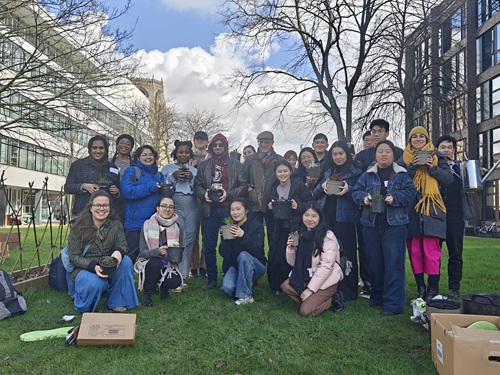
OPENspace Co-Director, Prof. Simon Bell, was invited to speak at the ‘Connecting through Nature’ interdisciplinary gardening and wellbeing workshop for postgraduate researchers (PGRs) at the University of Manchester on 11th March.
The workshop, which focused on sustainable gardening and landscape-wellbeing design, explored the relationships between landscape, health, and sustainable urban environments.
Prof. Bell’s lecture, “Connecting Through Nature: Urban Allotment Gardening and Wellbeing in Europe”, drew on insights from the edited volume Urban Allotment Gardens in Europe. The session explored the historical evolution, governance, and socio-ecological significance of urban allotment and community gardens across European cities.
Through comparative case studies, Prof. Bell highlighted how allotments contribute to food security, biodiversity, social cohesion, and cultural identity, while also revealing tensions around land tenure, planning policy, and gentrification.
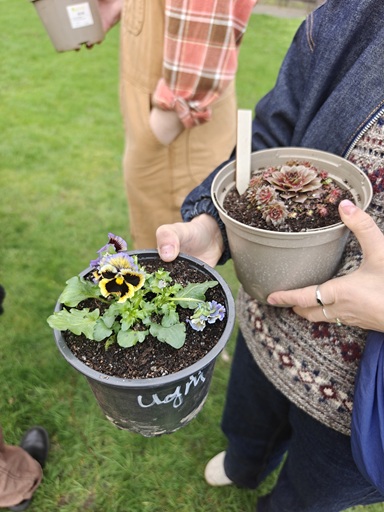
Alongside the lecture, participants took part in a hands-on gardening activity, creating small plant installations using recycled materials. The workshop combined practical making with shared reflection and research-led discussion, encouraging interdisciplinary dialogue across planning, geography, and architecture.
Connecting through Nature Workshop – Planting session
As the global population shifts toward urban living, non-communicable and lifestyle-related health conditions are increasing. Chronic stress contributes to depression, anxiety, obesity, heart disease, and reduced focus — even among people who appear otherwise well. At the same time, economies are struggling with the rising costs of healthcare. Yet, the gap between what we know and what we do in city design remains immense.
This webinar explores how landscape architecture can help bridge that gap. Bringing together research, practice, and insights from salutogenesis, it will examine how contact with nature and thoughtfully designed urban landscapes can reduce stress, strengthen wellbeing, and support healthier everyday environments.
Join us at the exhibition launch of the Joint Laboratory of Healthy Space student research and design work followed by a seminar from Dr Mo Han
From 9-13 February, 2026 an exhibition will be held in the Matthew Gallery in Minto House, Chambers Steet, showcasing three different sets of work associated with the Joint Lab of Healthy Space established between the School of Design and Art at Beijing Institute of Technology (BIT) and OPENspace Research Centre and Edinburgh School of Architecture and Landscape Architecture at ECA. This joint lab was set up in early 2023 and collaboration has included summer schools, doctoral seminars and joint publications.
This exhibition features results from the 2024 summer school in BIT, where designs were intended to improve a blue space in Beijing, outputs from the MArch programme at ESALA which feature the design of edge structures along blue spaces, results of the Landscape and Wellbeing programme course on “Landscape design for health and wellbeing” featuring the Union Canal in Edinburgh and doctoral research in landscape architecture which focuses on various types of green and blue spaces and their health and wellbeing potential.
The curators of the exhibition are Professor Simon Bell, co-director of OPENspace, Iain Scott, Senior Lecturer responsible for the MArch course which is showcased, and Dr Mo Han, Associate Professor of BIT and organiser of the summer schools.
Following the opening, Dr Han will present some of her work at an OPENspace seminar, to take place in Seminar Room 4 at Minto House.
Exhibition launch details
Date and Time: Monday 9th February 2026, 12pm
Location: Matthew gallery, Minto House, Chamber Street (In-Person only)
To Register to view the Seminar online please sign up for an online admission ticket through the exhibition event and a Seminar link will be sent to you.
Title: Integrated Strategies for Rural Landscape Planning and Sustainable Development based on Landscape Character Assessment and Cultural Ecosystem Service.
China is currently facing a comprehensive undertaking of rural revitalization. In order to continue the Chinese agricultural civilization and explore the profound rural civilization of our country, it is necessary to base on the historical heritage of rural civilization and the deep value of rural landscapes, and promote the organic unity of rural culture with agricultural economy, ecological environment, and social value. This study is based on the theory of Landscape Character Assessment, deeply analyzes the essence of rural landscape features in China and their Landscape Capacity in response to transformation, and incorporates artificial intelligence technology to carry out scientific and precise pre-planning for rural development, aiming to organically integrate the protection of rural historical value with the development of rural ecological civilization.
Speaker Bio:
Mo Han is an Associate Director of BIT-UoE Joint Laboratory of Healthy Space and Associate Professor at the School of Design and Arts at the Beijing Institute of Technology.
A delegation from the Faculty of Architecture and Landscape Architecture at Harbin Institute of Technology (HIT) – Professor Yang Yu, Associate professor Qi Guo and two PhD students Keli Wang and Yuxin Huang – visited ECA, ESALA and OPENspace on the 26 and 27 of November. They toured the architecture and landscape architecture studios with Iain Scott and Simon Bell, met ESALA staff to discuss cooperation and joined a research seminar with landscape architecture PhD students. Simon Bell has been teaching at HIT since 2015 and has built strong connections with the staff and students.
Our relationship with the window, as an architectural feature or building element, is manifold. During the pandemic lockdowns, windows were both the metaphorical and literal connection to the outside world for many. From a technical perspective, windows also provide one of the most fundamental ways of ventilating the indoor environment, now a key parameter to ensure safe return to our workplaces. I will discuss some preliminary findings from a questionnaire survey on windows in people’s homes conducted in Scotland at the end of the first lockdown.
Research into the potential health and well-being benefits from exposure to green spaces such as parks and woodlands has led to the development of several frameworks linking the different strands of evidence. The current talk builds on these to provide a model of how exposure to aquatic environments, or blue spaces such as rivers, lakes and the coast, in particular, may benefit health and well-being. Although green and blue spaces share many commonalities, there are also important differences. Novel aspects of our framework include the inclusion of outcomes that are only indirectly good for health through being good for the environment, the addition of nature connectedness as both a trait and state, and feedback loops where actions/interventions to increase exposure to blue landscapes are implemented. Limitations of the framework and areas for future work, including the need to integrate potential benefits with potential risks, will be discussed.
Physical crowds and psychological crowds: Incorporating group behaviour into crowd models
Models are used to simulate pedestrian behaviour for safety at mass events, yet these models often neglect the psychological factors influencing collective behaviour. Over two studies, we explored the role of group identification on pedestrian movement, both in unidirectional and bidirectional flow. Results suggest that group members will collectively self-organise their speed and distance walked in order to maintain close proximity and avoid outgroup members. Based on these studies, I make suggestions for including group behaviour in pedestrian models and broader implications for safety planning. https://vimeo.com/531297941
Rolf Roscher, director of Glasgow based Landscape Architects erz, will discuss the practice’s health and care projects. Over the past 14 years erz have designed and overseen delivery of a wide range of innovative health and care projects. These include masterplans and strategies for existing hospital campuses and new facilities focused on mental health, physical health and end of life care. Projects discussed will include the new Prince and Princess of Wales Hospice in Glasgow (winner of the Excellence in Landscape Design category at the 2020 Landscape Institute Awards) and the first phase of the redevelopment of the Royal Edinburgh Hospital campus. https://vimeo.com/528315921
You Really Do Become Invisible’: Exploring Older Adults Rights to the City
A global ageing population presents opportunities and challenges to designing urban environments that support ageing in place. The World Health Organisation’s Global Age-Friendly Cities movement has identified the need to develop communities that optimise health, participation and security in order to enhance quality of life as people age. Ensuring that age-friendly urban environments create the conditions for active ageing requires cities and communities to support older adults’ rights to access and move around the city (‘appropriation’) and for them to be actively involved in the transformation (‘making and remaking’) of the city. This raised important questions: what are older adults’ everyday experiences in exercising their rights to the city? what are the challenges and opportunities in supporting a rights to the city approach? how can the delivery of age-friendly cities support rights to the city for older people? This paper examines these questions through presenting the lived experiences of older adults across three cities and nine neighbourhoods in the UK collected through an Economic and Social Research Council (ESRC) funded three year project.https://vimeo.com/517076102
The second phase of our work on Memory-Friendly Neighbourhoods wraps up in January 2017 with an event at the Scottish Universities Insight Institute.
In this phase of Memory-Friendly Neighbourhoods (MFN), we’ve been focusing on the ‘virtual neighbourhood’, looking at how people living with dementia use and navigate online environments.
The programme is based on our own experiences of setting up the MFN website and the lack of guidance we have found on internet accessibility for people living with dementia.
We’ve been using a survey, together with a ‘town hall meeting’ approach, to engaging participants; from people who commission, design, build and maintain websites, to people whose lives are affected by dementia.
Please join us at our final meeting where we’ll be discussing what we’ve found out and co-designing outputs from the project, including ideas for next steps and recommendations for policy and practice.
The event takes place at the Scottish Universities Insight Institute, a short walk from Queen Street Station in central Glasgow, on Tuesday 17th January 2017.
The meeting will last from 10am until noon and you are welcome to stay for lunch afterwards.
Memory-Friendly Neighbourhoods is a knowledge exchange programme with the University of Stirling exploring how local communities can support people with dementia. It is funded by the Scottish Universities Insight Institute and partnered by Age Scotland, East Dunbartonshire Council, and Life Changes Trust.